
Disabled Parents Interview w/Olivia de Fleuriot Perry
An offshoot of the Expectant series

Disabled Parents Interview is just that—interviews with people who identify as disabled parents sharing their experiences around disability and parenthood. Here is my attempt at assembling a handful of stories and experiences!
Below is an interview with our fifth(!) disabled parent of the series, Olivia de Fleuriot Perry. Olivia de Fleuriot Perry is a multidisciplinary artist based in Milton, ON. Working primarily with ceramics and painting, de Fleuriot Perry explores the connection with her local plant community through repetition and attentive care. Her process—often physical and immersive—combines written imagery, performative image-making, sculptural installations, drawing, and painting to fragment and reinterpret flora into colour, texture, and light, reflecting a deeply embodied, cyclical practice of care and observation. She is a parent to three boys.
Olivia Dreisinger: What were your pregnancy experiences like? What was hard? What was good?
Olivia de Fleuriot Perry: My first pregnancy was textbook with no complications. I was fat and happy (minus the bouts of prenatal depression towards the end of my pregnancy). My second pregnancy had some complications. I had a subchorionic hematoma identified at week 20, which led to a total of 9 ultrasounds until week 29 of gestation. This caused me a lot of anxiety and depression. In my third pregnancy, I miscarried at 10 weeks. I was excited to be having a girl (I thought I was, as I did the blood test at 6 weeks gestation - I now know she had already died and it was only my DNA reflected in the results… I still call her my little Fleur as I did for a month). I found out that she had stopped growing at 4 or 5 weeks gestation. I held her in my womb, deceased for 5 or 6 weeks. I passed her protective fleshy cushion. I could not see her, but I held her for a moment before flushing her down the toilet. In my fourth pregnancy, I did not want to be pregnant. I was still mourning the loss of my third child only 4 months after miscarrying. I did not share the news except with close family until 30 weeks pregnant. I cried a lot and had a trapped uterus at 14 weeks, which caused major urinary retention (I had to have a catheter for a week). Being pregnant the fourth time was very difficult for me. Even though it was hard, I actually loved my round belly.
Olivia Dreisinger: What were your birth experiences like?
Olivia de Fleuriot Perry: My first birthing experience was traumatic. I had J way too fast and only got to the hospital less than 2 hours before he was born. I had back labour, which I did not handle well, pain-wise. When they placed him on me after he came out of my body, I did not feel a connection with him. He was like a slimy alien crying on my chest. I was too concerned about the shock of it all and the doctor stitching up my 2nd degree tear. In my 2nd birthing experience, I was induced at 36 weeks as I was bleeding and amniotic fluid was detected. As soon as I felt back labour starting, I requested an epidural. I spent the day napping and resting as I slightly felt contractions. I was able to feel when my body wanted to bear down, and I warned the nurse that I would birth quickly, so she ran to get the doctor. E was born 10 minutes later. It was easier to connect with the slimy alien on my chest (even though I tore again) as I already had the experience of bonding with my first child. The third birthing experience, I made sure to go straight to the hospital as soon as I felt contractions and request an epidural right away (before back labour even started, as I knew it was coming). I again relaxed until I felt the need to bear down. The doctor arrived right before A was born after 5 minutes of pushing. I loved the baby on my chest even though there was a shroud of sadness remembering Fleur.
Olivia Dreisinger: What were your postpartum experiences like?
Olivia de Fleuriot Perry: In my first postpartum experience, I had postpartum anxiety (I didn't know it at the time). I was fixated on controlling everything that involved my baby, causing me to seclude myself for months. J did not want to breastfeed, so I pumped and bottle-fed him for the first two weeks. Thankfully, he eventually took to breastfeeding, and I breastfed him for 12 months until a few days before I went back to the MFA program at Emily Carr University. J went to daycare, and I went to school. During my second postpartum experience (during a lockdown in 2020), I had postpartum depression. My first child was 3 years old and needed me socially, while my premature baby breastfed every hour for 4 months (with 15-minute naps every hour). I realized I needed medical help and had therapy (online - I learnt to focus on the emotion initially and not the behaviour when parenting my firstborn child. This gave me something to focus on when difficult moments arose instead of feeling like I couldn’t escape) and started antidepressants. The medication I took helped me for 2 weeks of every month. I had major mood swings from elation to suicidal ideation on a monthly basis. This went on for 3 years. I did not make much art during this time. My third postpartum experience was after the loss of Fleur - the pain was so unbearable I was afraid to let any emotion out. This caused me to change the antidepressant I was using. During this time, we were having financial insecurity, I fell pregnant with A, and my partner lost his job (caused by post covid events). This led to us moving from BC to ON to live with my parents. They gave us three bedrooms and lots of love. We still live with them, and we are thankful every day for their support. We have made use of the space we have. My partner’s and my bedroom is also his office; A’s room is also my studio; and E and J share a room. In my fourth postpartum experience, I had postpartum anxiety and depression. A slept well from day one and had no issues breastfeeding. I only had the capacity to take care of my baby and not my older two children for the first 6 months. I slept in my baby’s bedroom for 6 months separate from my partner. When I was 8 months postpartum, I finally upped the dose for my meds to the right amount. I started painting again, and I have not stopped since Sept. 2024.
Olivia Dreisinger: How has disability and illness impacted how you approach being a parent?
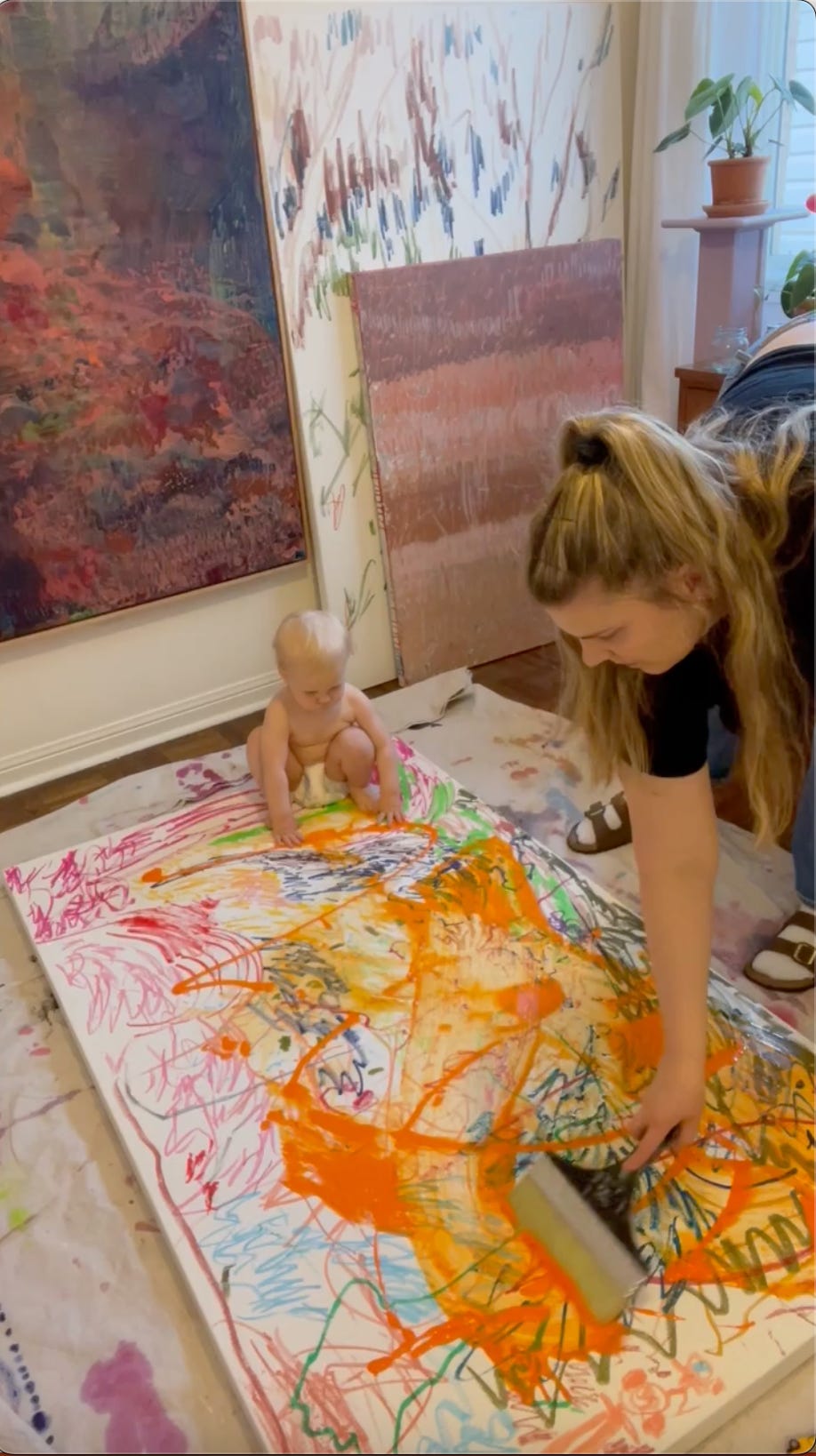
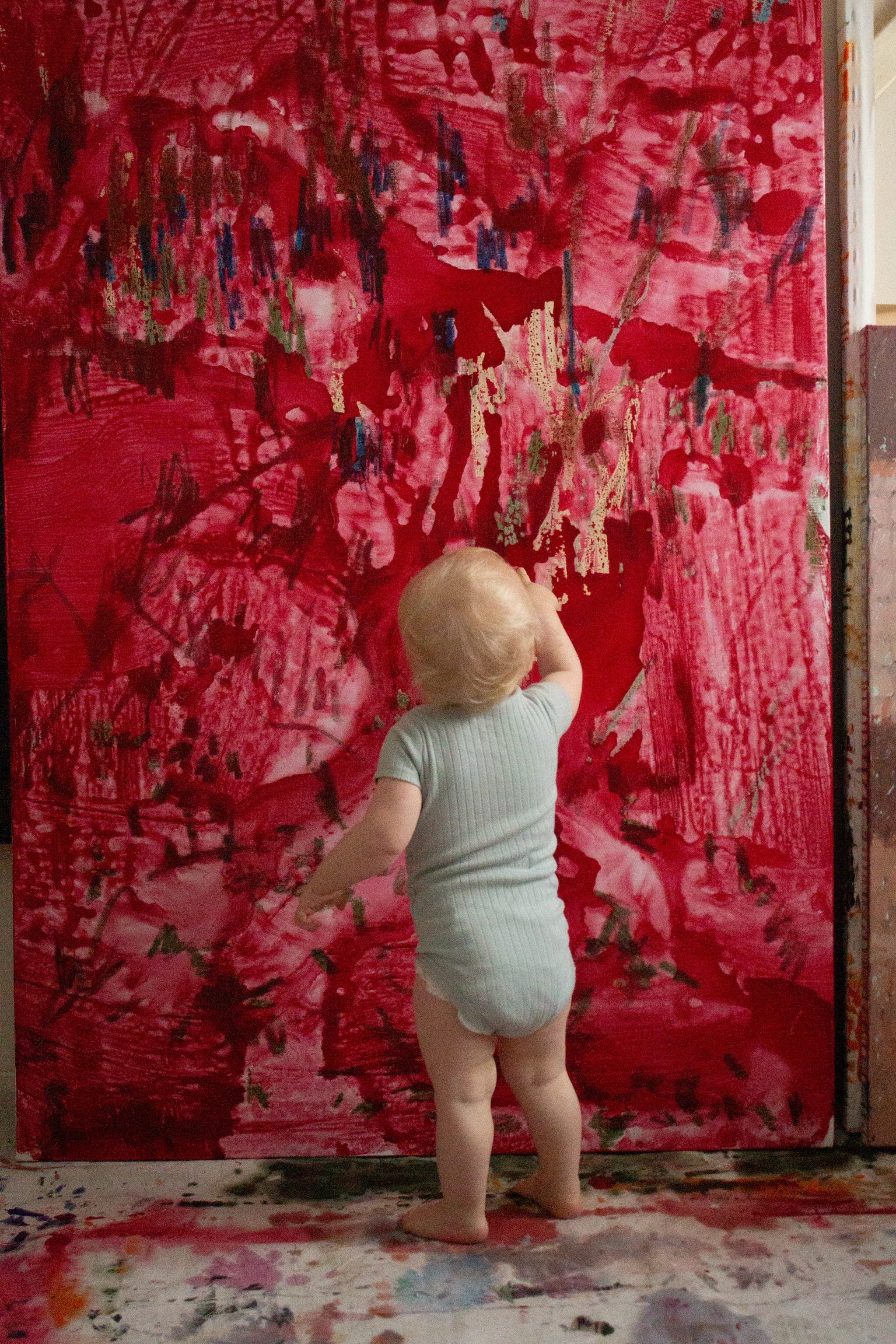
Olivia de Fleuriot Perry: My children made me who I am today. If it wasn't for them, I would not have sought help. I went through that hardship to truly discover myself, and through that transformation I am now making art prolifically (in part to manage my mental illnesses but also because it makes me happy). I hope to one day transition from taking antidepressants through cognitive behavioural therapy techniques and trying ADHD medication on a regular basis. I have learnt to pivot - when I feel an episode rising, I change my environment. I go for a walk, and I communicate with my spouse if I need a minute to make art, lie face down on the bed, or read a book. We are a team now, which makes a huge difference (we have learnt how to communicate with each other over our 13 years together). My partner knows when I am slipping into depression and that I need to get out and do something. He has learnt my warning signs. I, at times, feel guilty for burdening him. It helps to remind myself to breathe and change my environment - I have agency to pivot and do something else (this has caused the problem of never stopping, always moving, which is a problem I need to address - working on it… kinda). This has led to my current art practice where I make alongside my children. We also go adventuring together at the creek near our home, which is my main source of inspiration for my creative research. I actively identify what is causing me to feel stuck, and I make a mental shift to include the barrier, often making it pivotal to my movement/making. I have a fear of sinking into depression again, being so down I can't move for days. My lethargy was crushing… thinking back, I have realized I was in a constant depressive state for 20 years since I started puberty- what I thought was my norm was not who I was. I was living with an unspecified mood disorder, compulsive OCD and ADHD without any help. My symptoms were normalized, or I was told I was too sensitive or too quiet or too aloof, or too sullen, or to smile more. Now, I look back to my childhood and see the 5-year-old girl who spent hours in the garden amongst the flowers, the trees, the birds, and the bugs. I consider that girl’s face, mind, and spirit standing before me, smiling – she knows she has been found.
Olivia Dreisinger: What advice would you give other disabled people thinking about having a family?
Olivia de Fleuriot Perry: Be kind to yourself; don’t pay attention to people who are negative, criticize, belittle you, or cause anxiety FOR NO REASON just because you are a new parent and they think they have the right to make you feel less than. Communicate!!! Communicate to your partner, your family, your children, your friends, your doctor, your therapist, psychiatrist, psychologist, etc. (I finally got properly diagnosed and medicated through persistent communication which was not natural for me to do but I was desperate to be better for my little humans) and learn what you need to pivot/train your brain to go to that place if you can’t physically move or get away from your precious triggering beings. It is incredible how secure my kids feel with my fluctuating moods because I communicate when I need space or if a particular activity is causing me to be overstimulated. I am clear and direct with my boundaries. This avoids exploding or imploding bodily responses. My kids know what I can handle and what I can’t, and they respect that because I have clearly communicated how certain noises or activities affect me. Try to shake off the guilt (easier said than done) - do what is right for YOU and your child. Don’t sacrifice your physical, mental, or emotional health for your kids. Practice methods (I suggest cognitive behavioural therapy) to cope with the times you can't escape the nightmare of raising children, and cherish the moments when they are snuggled in your arms like little angels. Write down what they say! I have running notes on my iPhone of quotes from my children with the date and time they said it. Again, listen to what people have to say, take what resonates with you, and ignore the rest if it's unhelpful. Love you all <3
Olivia Dreisinger: Anything else you’d like to say?
Olivia de Fleuriot Perry: This is my experience; remember, everyone experiences this stage of life differently. Take the nuggets that are helpful and ignore the rest! There is not one way to parent; this is how I have learnt to cope and thrive with my ongoing mental illnesses. I love being a mom, and my kids are my everything (all 4 of them).


Thank you for taking the time to hear my story ❤️